Travelogue #2 Prospect Cottage
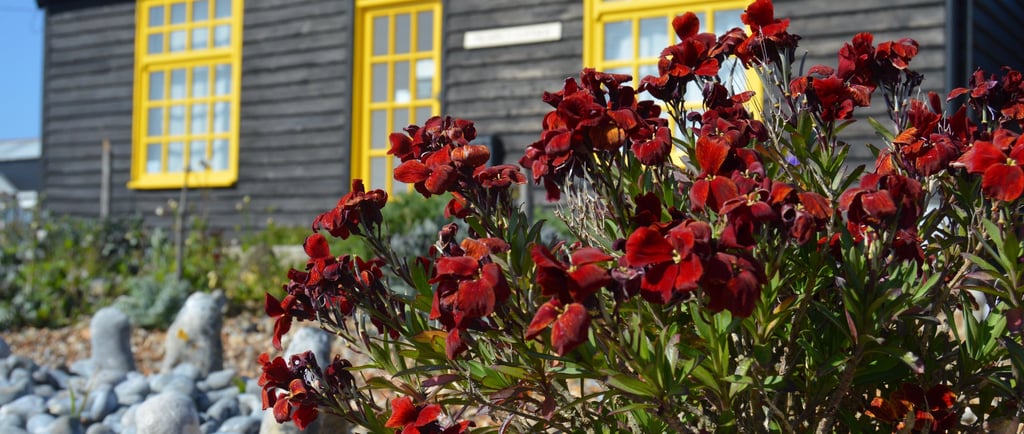
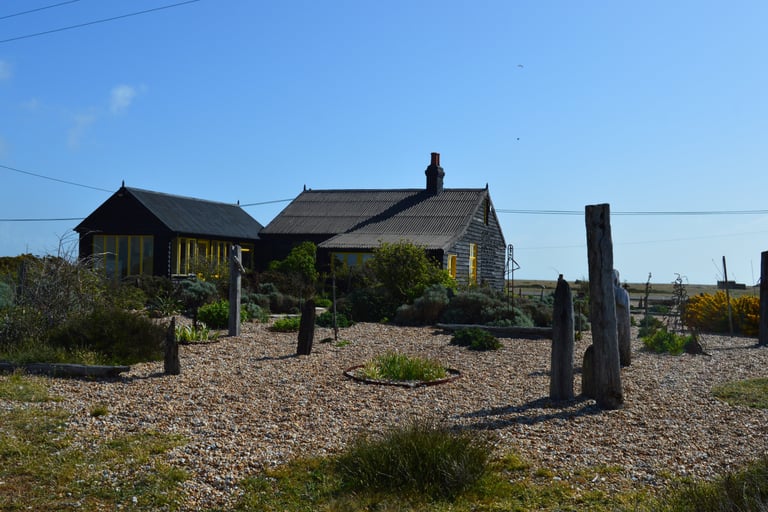
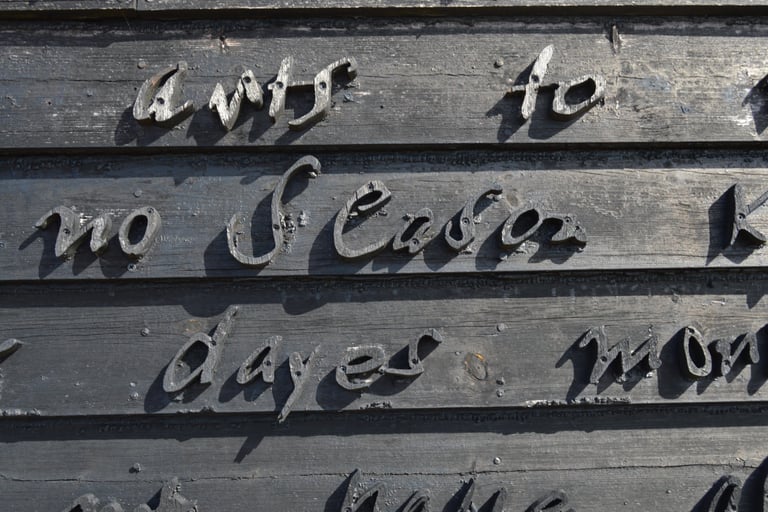
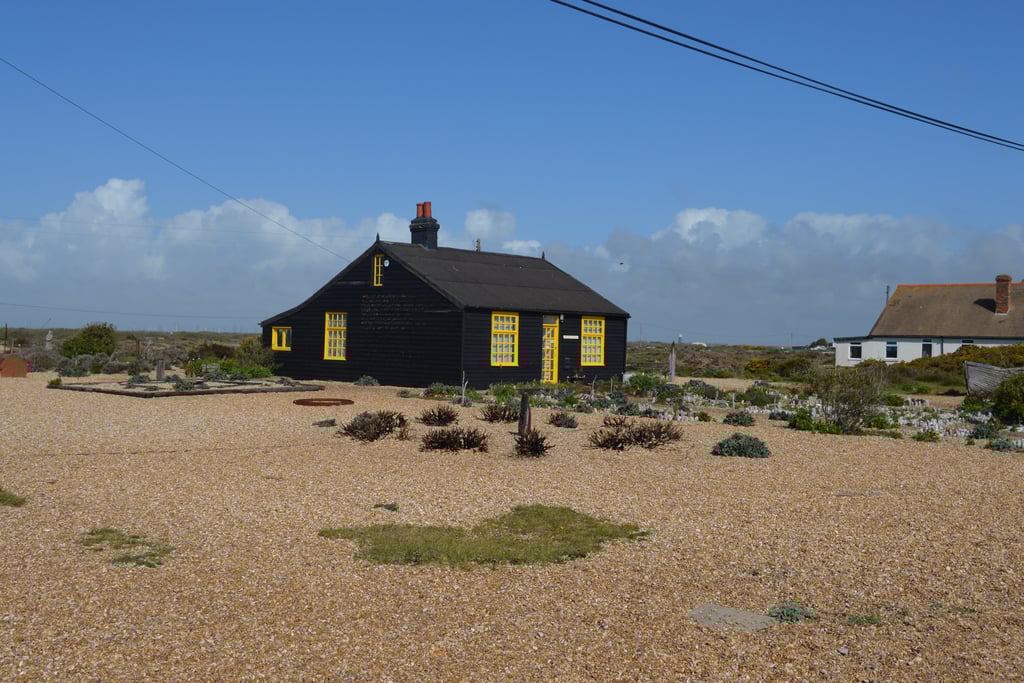
Prospect Cottage is unmistakeable. Its burnt blackened walls, its dijon yellow windows, John Donne’s words giving way slowly down the east wall. Open to the road, it is a garden without borders or boundaries. A garden made into shape by finds from the sea.
6 min read
*All photographs Gavin Stoneystreet
Travelogue #2 Prospect Cottage, 2019.
I had breakfast on the shale at Lydd on Sea. It is a ramp of stone which forms a steep and unwelcoming arrival to the waves. There is a boat grounded high near where I sit with a bread roll and a bitter black coffee in my travel cup. But I wasn’t really thinking about my coffee, or the steep unsteady bank to the sea. I was thinking of Derek Jarman’s garden at Prospect Cottage, the place I was heading to after my coffee. A garden that by all accounts was destined to return to the sea if left alone long enough. Though it isn’t left alone long enough. Nor ever will be. It has become horticulturally hallowed and thus stays in stasis. A temporal garden trapped between ages.
I was in the academic mind, qualifying a thing with rigorous argument. Measuring everything up, valuing and evaluating. While it is helpful to making sense and order of things, it is a reductive and gut-absent way of assessing the world. Fact before feeling, that was the exercise of academic writing and I caught myself doing it here. Before I even glimpsed it, I was refining an argument based on good solid rational ideas.
I tipped the last dregs of coffee to the shale and climbed inelegantly back to the road for the short drive along the coast. I abandoned the car soon on. I wanted to approach it on foot. It is the kind of landscape that isn’t meant for cars. Dungeness is both tiny and vast, both mundane and enchanted. It demands that you let yourself vanish into it. You are walking off the end of the world.
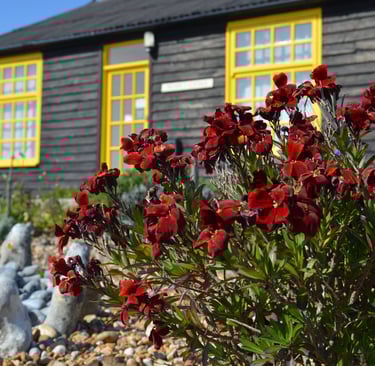
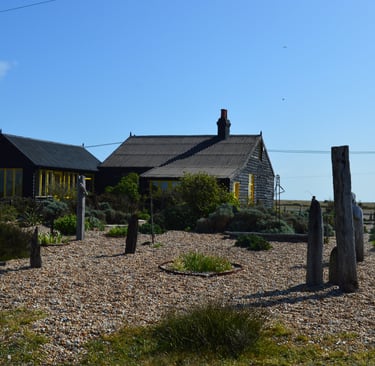
Prospect Cottage is unmistakeable, at least to any self-respecting garden enthusiast. Its burnt blackened walls, its dijon yellow windows, John Donne’s words giving way slowly down the east wall. Open to the road, it is a garden without borders or boundaries. The garden made into shape by finds from the sea. The pattern of rocks and pebbles are strangely formal around the front. Traditional English country garden tropes rendered in unfamiliar materials. Amongst the small palette of flowers Valerian grows in starved wind-ravaged whips, beautiful red bruising to the stems, unrelatable to the easy profusions it makes back at home. It is a feeling garden rather than a fact garden, and my earlier academic rulings of heritage viability are invalidated on the spot. The resilience of it catches in the throat. It stands in defiance of the great west wind, while at the same time dancing with it. The weary half-worn half-washed tones of the orange Erysimum in the barrenness of its exposed home, is life making a place for itself in spite. It is also life giving way.
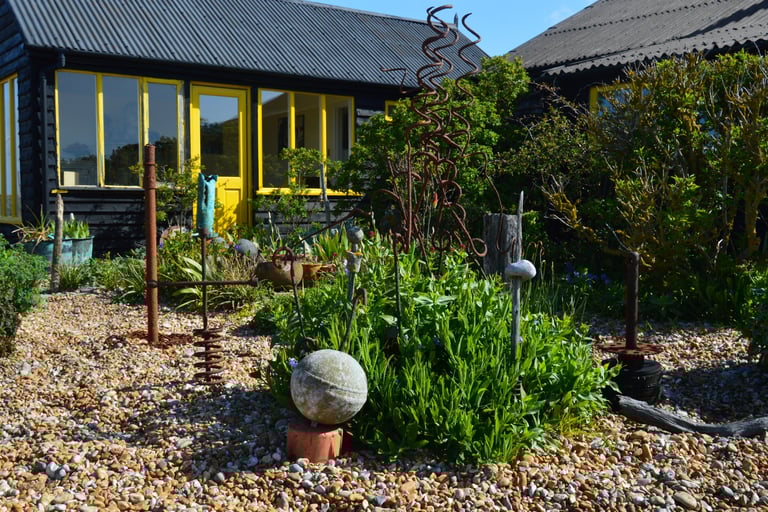
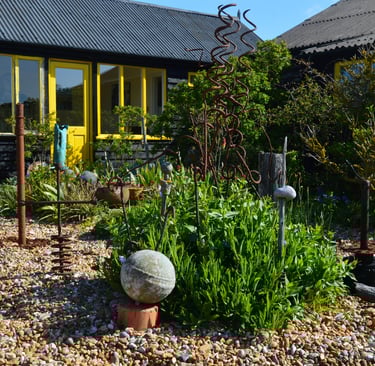
Remnants of earlier readings of Jarman’s Modern Nature return in bursts through my memory while I perch on the shale. I see him adding manure to the earth-less ground. The singular need to make life and beauty. I imagine the great storm of ’87 rattling the corrugated skin of the place, the collection of sea-finds being swept away once again. Jarman agitating at the savage energy outside. I remembered when hurricane winds took some of my roof away when living on a small north Atlantic Island. It can feel as though the elements are coming for you, in active attack. Prospect cottage doesn’t look substantial enough to have held its resident artist safe, but it did. And still it stands. The making and the shaking of the garden through the life of its maker continue to haunt it. The place yearns for Jarman’s return. It is a storied place. It is a poem.
The back of the cottage is another thing. It is as informal as the front was formal. The collections retrieved from the sea, rusting parts of boats and seafarers’ treasures, fishermen’s minutiae, and absent sea life. Plants that have no business there make a case for beauty out of the scrap.
The backdrop of the power station is moving in its way, wholly appropriate and disconcerting. This place is the outpost of life and the threat of it being extinguished is ever present. If the storms don’t get you, the fallout will. The sense that you may be at the end of the world makes you feel more alive.
I stayed a while, all alone and grateful for the reflection that it enabled. I replaced a couple of errant features. The garden, the landscape, the power station, it all fed into a heightened sense of aliveness. Later a few words shared with the neighbour who was hanging washing. I wondered what life would become for them as the cottage’s fame grew. The cars blocking the driveway and the steady stream of people to view what is a very small space for a public garden. But it is a public garden now. It is in the public consciousness, has become part of the English garden vocabulary. That in itself is reason enough to preserve this unpreservable transient assemblage of stone and plant-life. I can’t help but render the impossibility of its saving even as I declare it must be saved.
But it won’t be saved. Not really. Because it is already mostly gone, morphing into a simulacrum. The idea of it will be saved, and a rendering of it. It hasn’t really been Jarman’s garden since Jarman gardened it. Sometimes a garden can live on a good while after its maker passes, but plants are stubbornly independent things and will become something else eventually. And in a place like Dungeness the weather will change the rest of it. But that is getting caught up in the materiality of the thing, to lose sight of the vision and intent and emotional heft of its being. Jarman’s idea, his canvas, his philosophy, his need of this otherworldly plot in that moment, that is all here still, worth a pilgrim’s journey. That can all be heritage-ised.
The garden is largely trapped inside Howard Sooley’s photographs. It will be somewhat materially chained to that particular moment now. No matter what the garden looked like in the years Jarman played with it, it is a likeness of the photographs that visitors will seek. The icon is born in the image. Physically, we see the garden through his lens, not through Jarman’s eyes.
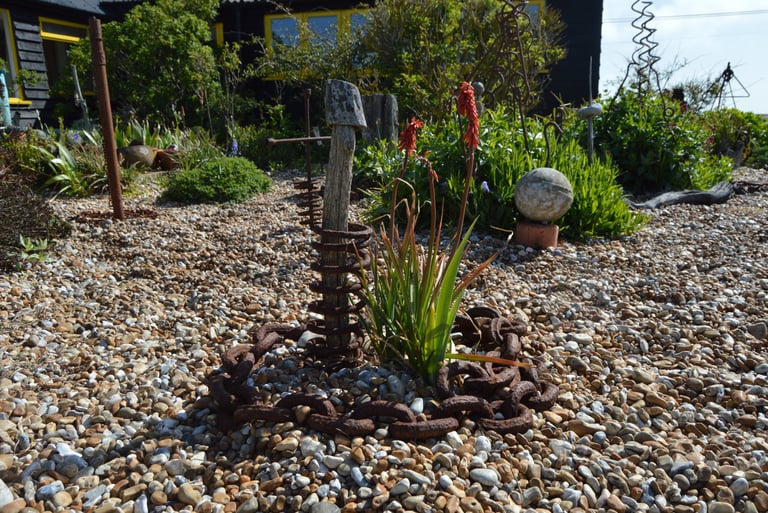
I spent the rest of the day in a kind of dream state, wandering between the beautiful decay of boat wrecks, the brightness of shingle devoid of other life, the whipping waves of the sea current, the bladder campion flowering in any sheltering spots where life is possible. Then before I left, a Hare stops in my path, we eye each other over, make a greeting. Hares and I have history, have business, it is never a chance encounter. I am unsettled by my day in Dungeness, much to chew on. I abandon my plan to visit St Thomas a Becket for another day, I cannot be moved any more today, heart ringing like an over-worked tuning fork.
Prospect Cottage is worthy of garden heritage status, mostly because of it uniqueness. Its atmosphere and emotional content are not comparable to anywhere else I have been. While I like the thought of Dungeness left alone, not over-peopled, I also think people should see this garden, to feel its whisper of resilience and beauty-making. Its emotional weight comes from its temporality; the fleeting moments of love and tending in the harsh transience of life. A message that can only be shared if some fixity and semi-permanence is imposed upon it. I am slightly in love with its baked-in contradiction.
All images taken by Gavin Stonneystreet